
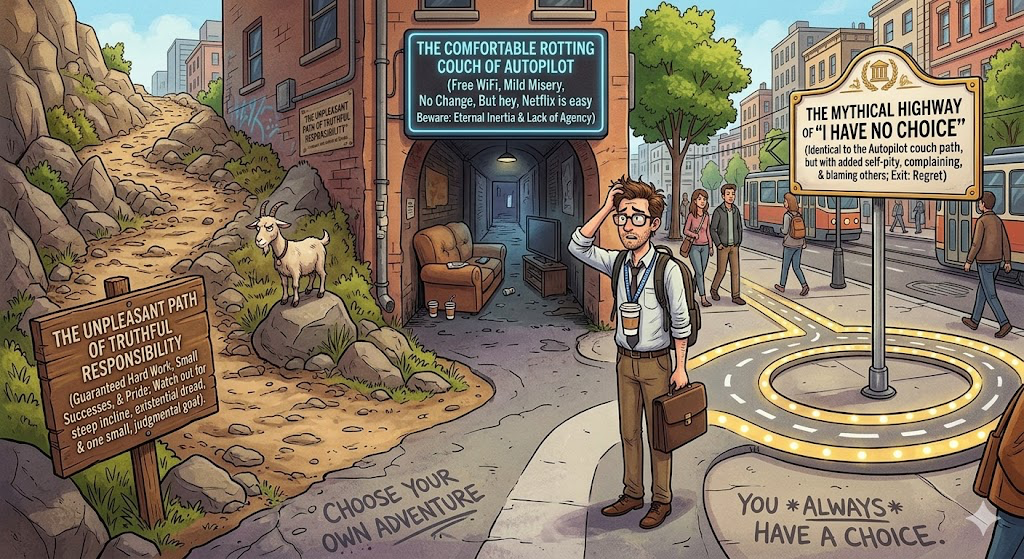

We say it all the time: “I didn’t have a choice.”
We say it when we stay in a soul-sucking job. We say it when we follow a rule we hate. We say it when we react in anger. It’s a convenient phrase because it absolves us of responsibility. If there was no choice, there is no blame.
But here is the secret that institutions, overtaxed brains, and even our own fear would rather we forget: You always have a choice.
Choice isn’t just a luxury for the lucky; it is a constant, shimmering possibility that exists in every single second of your life.
The Illusion of “No Choice”
When we claim we have “no choice,” what we usually mean is that we don’t like the alternatives. Every choice comes with a price tag. Often, the remaining options carry heavy penalties or social “unacceptability.” Choosing to quit a job without a backup has the consequence of financial instability. Choosing to speak your truth might mean social friction. Because we find those consequences “unacceptable,” we filter out the choice entirely.
But a choice with a high price is still a choice. When we acknowledge that, we move from being a victim of our circumstances to being the architect of our trade-offs.
Why Your Brain Wants You to Forget
If choice is so powerful, why do we “forget” we have it? It’s not a character flaw—it’s a survival mechanism.
- Decision Fatigue: Your brain is an energy hog. Weighing options is exhausting. To save fuel, your brain creates “autopilot” routines. Over time, we stop seeing these routines as choices and start seeing them as “just the way things are.”
- The “Safe” Rut: Even a miserable situation can feel safer than an unknown one. The brain prefers familiar pain over unfamiliar risk.
- Learned Helplessness: If you’ve spent years in a restrictive environment (or a toxic one), you might have internalized the belief that your agency doesn’t matter. You stop looking for the door, even when it’s unlocked.
The Internal Fortress: Lessons from the Extreme
Perhaps the most profound evidence of human choice comes from the darkest places. Psychiatrist and Holocaust survivor Viktor Frankl observed that even in the unimaginable horror of concentration camps, one freedom remained untouchable:
“Everything can be taken from a man but one thing: the last of the human freedoms—to choose one’s attitude in any given set of circumstances, to choose one’s own way.”
No matter how restricted your physical world is, your Internal Fortress belongs to you. You are the sole author of:
- Your Meaning: You decide the “why” behind your struggle.
- Your Attitude: You can choose resilience over bitterness, or acceptance over rage.
- Your Focus: You decide whether to dwell on the bars of the cage or the patch of sky visible through them.
The Rule of Three
In any given situation—no matter how dire—you have exactly three paths. If you feel stuck, it’s usually because you’ve forgotten one of them:
- Change it: Take action. Alter the environment. Negotiate the terms.
- Accept it: If it cannot be changed, accept the reality with dignity. This isn’t “giving up”; it’s a strategic decision to stop wasting energy on the impossible.
- Resist it: Choose your internal stance. Even if you must comply outwardly, you can remain unconquered inwardly.
Re-Learning Your Agency
Choice is a muscle. If you haven’t used it in a while, it will feel weak. You can “re-wire” your brain by practicing small, conscious decisions every day. Choose a different route to work. Choose a different response to a minor annoyance.
As the Stoic philosopher Epictetus famously said: “People are disturbed not by things, but by the views they take of them.”
The secret is out. You are in the driver’s seat. You might not like the road, and you might not like the destination, but you are the one holding the wheel. What will you choose today?
Leave a Reply