
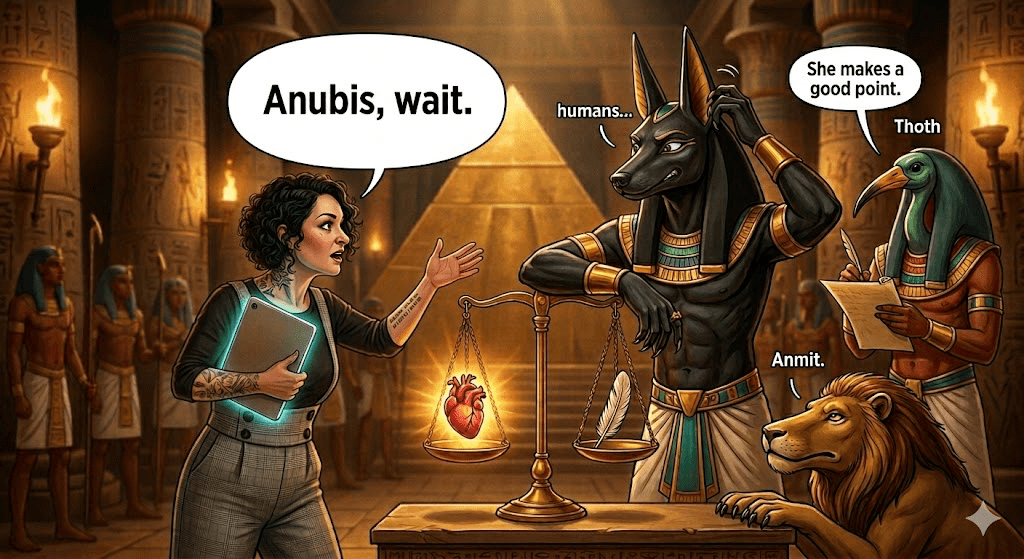
Fun fact: I want my heart weighed by Anubis when I die.
Trust me, if I could have it done periodically while I was alive I would request that as well, but as of right now it does not appear to be an option or have a subscription model. Not to mention it would probably kill me to have it removed and reinserted that many times in my lifetime.
So let’s start with a little background on heart weighing.
Once upon a time… In the heart of the Duat—the ancient Egyptian underworld—lies the Hall of Two Truths. This is where the deceased face their ultimate trial, presided over by the jackal-headed god, Anubis.
The story of the weighing of the heart is not just a myth; for the Egyptians, it was the definitive moment that determined whether a soul would enjoy eternal life or cease to exist forever.
The Journey to the Scales
After a person died and was mummified, their spirit had to navigate a dangerous landscape filled with monsters and magical gates. Eventually, they reached the Hall of Two Truths.
In the center of this hall stood a massive golden scale. On one side sat the Heart (ib) of the deceased, which the Egyptians believed held the person’s memory, intelligence, and emotions. On the other side sat the Feather of Truth, representing Ma’at, the goddess of cosmic order, justice, and harmony.
The Divine Cast
- Anubis: The “Guardian of the Scales.” He guided the soul and ensured the measurement was perfectly accurate.
- Thoth: The ibis-headed god of wisdom, who stood by with a reed pen and scroll to record the final verdict.
- Ammit: Known as the “Devourer of the Dead.” A terrifying demon with the head of a crocodile, the body of a lion, and the hindquarters of a hippopotamus. She waited hungrily at the foot of the scales.
The Negative Confession
Before the weighing began, the deceased had to address a panel of 42 divine judges. They performed the Negative Confession, swearing that they had not committed specific sins. They would say things like:
- “I have not stolen.”
- “I have not told lies.”
- “I have not caused pain to others.”
As they spoke, their heart—which couldn’t lie—was placed on the scale.
The Verdict
The moment of truth was a literal balance of weight:
- If the heart was lighter than the feather: This meant the person had lived a virtuous, balanced life. Anubis would lead them to Osiris, the King of the Underworld, who would welcome them into the Field of Reeds (a paradise resembling a perfect version of Egypt).
- If the heart was heavier than the feather: This meant the heart was weighed down by “heavy” sins and bad deeds. The balance would tip, and Ammit would immediately spring forward and devour the heart.
The Second Death: Being eaten by Ammit was the ultimate fear. It meant “non-existence.” There was no hell in the traditional sense; there was simply the end of the soul’s journey, forever.
Why Anubis?
While Osiris was the ultimate judge, Anubis was the technician of the afterlife. He was the one who physically knelt by the scales, adjusting the plumb line to ensure the measurement was fair. He acted as a bridge between the physical world of mummification and the spiritual world of the gods, ensuring that only the “pure of heart” could pass into eternity.
Let’s also talk about the feather a heart would be weighed against.
The feather used in the weighing ceremony wasn’t just any bird’s plumage—it was the Feather of Ma’at, the single most important symbol of law, morality, and the universe’s stability in ancient Egypt.
Here is everything you need to know about this tiny but mighty object.
1. The Goddess Behind the Feather
The feather belonged to Ma’at, the goddess of truth, justice, and cosmic order. While other gods had complex myths and tempers, Ma’at was more of a “divine constant.” She was the daughter of the sun god Ra and represented the way the world was supposed to work.
In art, she is almost always shown as a woman wearing a single ostrich feather in her headband. Sometimes, she is even depicted with wings, as if the concept of truth itself could take flight.
2. Why an Ostrich Feather?
Ancient Egyptians chose the ostrich feather specifically because of its symmetry. Unlike most bird feathers, where the barbs (the little hairs) are longer on one side of the quill than the other, an ostrich feather’s barbs are roughly equal in length.
- Symbolism: This perfect equality made it the ideal visual metaphor for balance and fairness.
- The Weight: While we think of feathers as “weightless,” in the Duat, the feather had a specific, divine weight. To pass the test, your heart didn’t have to be “zero”—it had to be in perfect equilibrium with the “standard” of truth.
3. The “Standard” of Truth
Think of the feather as the “Metric System of the Soul.” When Anubis placed the heart on the scales, the feather acted as the absolute truth. It represented the “Ma’at” (the order) that the gods established at the beginning of time.
- If you lived a “heavy” life: You were filled with isfet (chaos/dishonesty).
- If you lived a “Ma’at” life: You were in sync with the rhythm of the universe.
4. Living “in Ma’at”
The feather wasn’t just a scary thing waiting for you at the end of your life; it was a guide for how to live.
- For Pharaohs: Their primary job wasn’t just to build pyramids; it was to “uphold Ma’at.” If the kingdom was in chaos, it meant the Pharaoh had failed the feather.
- For Judges: Ancient Egyptian judges were often called “Priests of Ma’at.” They even wore small golden feather pendants as a sign of their authority. Some records suggest they would even draw the feather on their tongues with green dye so that every word they spoke was “true.”
Fun Fact: Because the heart was the only organ left inside a mummy (the others were put in jars), the Egyptians were effectively “pre-loading” the scale. They believed the heart was the seat of the soul and would “testify” against them if they tried to lie to Anubis.
The importance of weighing ones heart.
To the ancient Egyptians, the heart was much more than a pump for blood. Having it weighed was the ultimate “truth test” because of how they viewed the human body and the nature of the soul.
Here is the deeper significance behind why the heart—and only the heart—faced the scales.
1. The Seat of the Self (ib)
While we moderns view the brain as the center of thought, the Egyptians viewed the heart (called the ib) as the seat of intelligence, memory, and emotion. They believed the brain was merely “stuffing” that produced mucus (which is why they pulled it out through the nose and threw it away during mummification).
- The Significance: Because the heart “remembered” everything you ever did, it was the only organ capable of acting as a witness for or against you in the court of the gods.
2. The “Internal Witness”
The Egyptians believed the heart was a separate entity from the person. In the Book of the Dead, there are specific spells designed to prevent the heart from “rising up as a witness” against the owner.
- The Fear: You could lie with your mouth to the 42 judges, but you couldn’t lie with your heart. The weighing was significant because it represented a biological record of your morality that was impossible to forge.
3. The Only Organ Left Inside
During mummification, most organs (lungs, liver, stomach, intestines) were removed and placed in canopic jars.However, the heart was almost always left inside the chest or replaced with a “Heart Scarab” amulet.
- The Significance: A person literally could not enter the afterlife without their heart. If the heart was lost or destroyed before the trial, the soul was “dead on arrival.” It was the “passport” and the “ID card” for the Duat.
4. The Weight of Deeds (Isfet vs. Ma’at)
The weighing represented the Egyptian belief that actions have physical mass.
- Heavy Heart: Every time you acted with greed, malice, or chaos (Isfet), your heart grew physically heavier.
- Light Heart: Living in harmony (Ma’at) kept the heart light.
- The Significance: This meant that “salvation” wasn’t about faith or praying to the right god at the last minute; it was a cumulative “audit” of your entire life’s work.
5. Eternal Life vs. Non-Existence
Perhaps the most significant part of the weighing was the stakes. There was no “Hell” in the sense of eternal fire.
- The Reward: Becoming an Akh (an enlightened spirit) and living in the Field of Reeds.
- The Punishment: Non-existence. If the heart failed, Ammit ate it, and the soul ceased to exist. For the Egyptians, who were obsessed with legacy and memory, the idea of being “forgotten by the universe” was a fate far worse than any torture.+1
Now, The Egyptians believed the heart was the seat of the soul, and this may be correct, but I still think our heart is for others and our soul is for ourselves. They may live in the same space, but have very different functions.
BUT, that being said, I would really like to know the weight of my heart when I die. I’d like to know if the ways I gave my heart measures up. Also, do I have to be mummified to qualify? I mean does anyone do mummification anymore? Can you just hire someone to do that? I have a lot of questions and may need to update my will…
I do feel for Anubis if I ever get my chance. Poor guy is going to have to show me the numbers, analytics, etc. of the decision made. Like, can I get a print out of my life? I may have forgotten some parts. How does this system work? But I digress… I’m sure the heavy sighs you could get out of a jackal-headed god would really be something.
Either way, where do I sign up for heart weighing after death?
 mylifeinrambles.blog