
I hear about happiness every day. From patients. From friends. From family. From strangers who overhear me in coffee shops and decide to tell me about their pursuit of it. It is one of the most talked-about, most searched-for, most obsessed-over concepts in modern life. And I have started to think we are talking about it wrong.
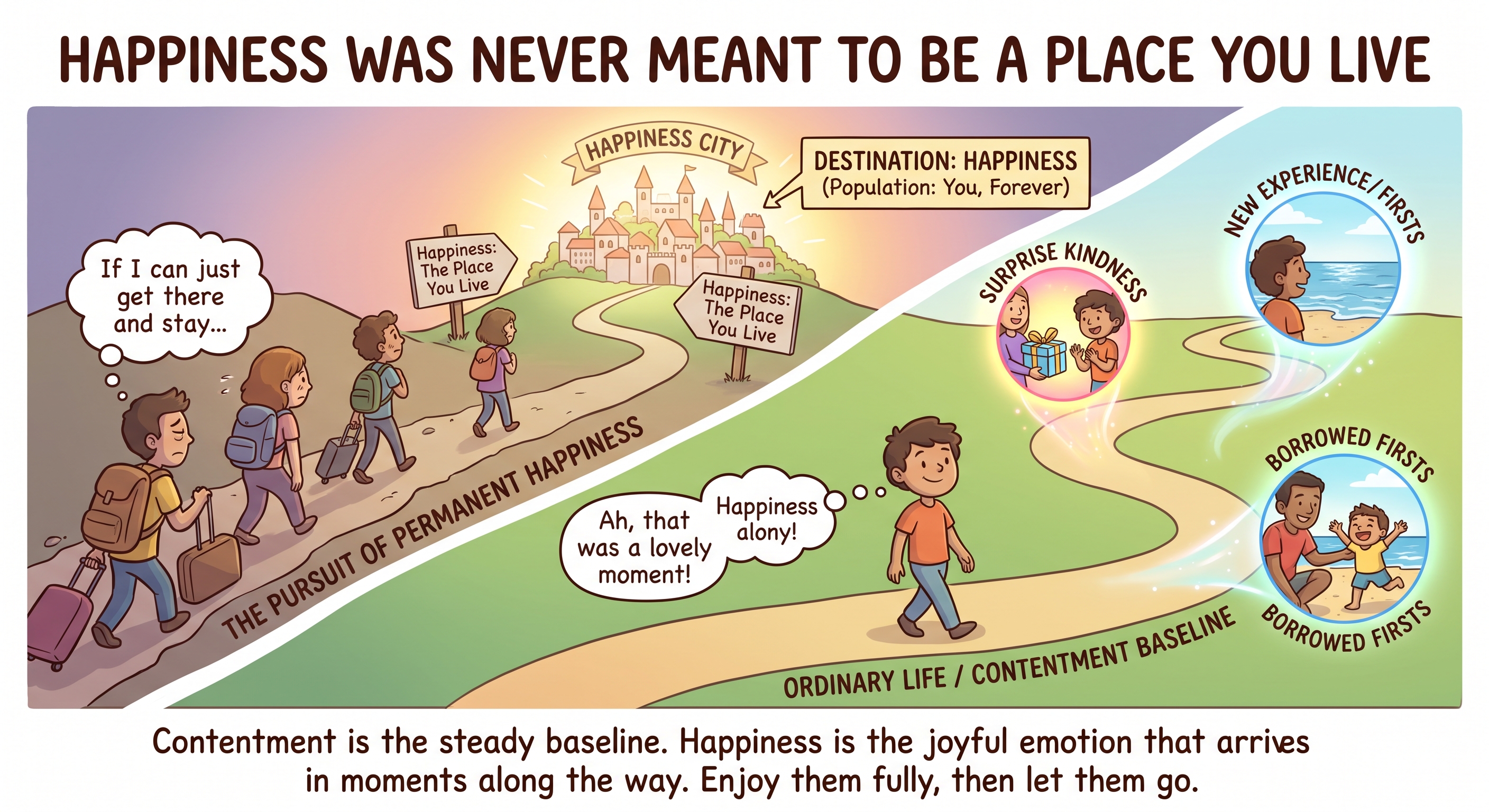
Because the way most people talk about happiness — the way the whole culture talks about it — is as though it were a place. A destination. A state of being that, once you arrive, you get to live inside for the rest of your life. People say things like I just want to be happy the way somebody might say I just want to live in the country. As if happiness were a location on a map. As if the only question were how to get there and how to stay.
Which is, I want to say gently, a fundamental misunderstanding of what happiness actually is.
Happiness is an emotion, not a state of being.
It is not sustainable as a continuous condition. It is not a location. It is not a personality trait some people are born with and others have to acquire. It is an emotion — one of many — that we experience in doses, triggered by specific things, felt for specific durations, and then, like every other emotion, receding to make room for whatever comes next.
This should be obvious. Nobody talks about being sustainably angry or permanently sad. We understand, intuitively, that anger and sadness are things we feel in response to things and then stop feeling when the things pass. But somehow, with happiness, we have decided the rules are different. We have decided that happiness is not just an emotion but the baseline state we are supposed to occupy, and that any time we are not experiencing it, we have failed at life.
This is not true. It has never been true. It is causing a lot of unnecessary suffering.
Happiness is caused. It does not arise from nothing.
Think about the last time you were genuinely, unambiguously happy. Not content. Not fine. Happy. Almost always, if you trace it back, you can identify the cause. It was the birth of a baby. It was a vacation. It was a specific holiday, a favorite meal, seeing somebody you love, receiving news you had been hoping for, being surprised by an unexpected kindness. Happiness is a response to something.A who, what when where, or why. It is not something you produce from thin air by having the correct mindset or the right morning routine or the appropriate crystals in your bedroom.
Which means the pursuit of general happiness — happiness with no cause, happiness as a lifestyle, happiness as a personality trait — is, in a real sense, the pursuit of an emotion without giving it anything to respond to. It cannot work. It is a category error. It is trying to see color in a room with no light.
What you can do is have experiences that produce happiness. Which most people do. The problem is that a lot of us have been trained by the culture to expect the happiness produced by those experiences to linger. To become the new baseline. And when it doesn’t — when the vacation ends and we return to ordinary life, when the holiday passes and January arrives, when the baby stops being a novelty and becomes a person who wakes us up at three in the morning — we conclude that something has gone wrong. When actually, nothing has gone wrong. The emotion has simply completed its cycle, as emotions do.
The other thing nobody tells you.
Happiness gets harder to access as you age, and there is a specific reason for it.
A significant amount of adult happiness is produced by firsts. The first time you traveled somewhere. The first time you fell in love. The first time you tasted a food you had never had before. The first time you saw the ocean. The first time you did anything, the freshness of the experience produced a specific kind of happiness that repeated experiences of the same thing cannot quite replicate.
Which means, mathematically, the older you get, the fewer firsts you have available. You have already been to that country. You have already had that meal. You have already fallen in love — several times, probably, at this point. The reservoir of firsts, which produced so much of your childhood and young adult happiness, starts to shrink. And you find yourself needing more elaborate, more expensive, more exotic experiences to generate the same amount of happy-emotion, because the ordinary ones have been used up.
This is one of the reasons happiness feels harder to catch in middle adulthood. Not because you are broken. Not because you are becoming cynical. Because the raw fuel of your earlier happiness — novel experience — has become scarcer, and you are trying to compensate with more of what worked before, which no longer works as well because you have had too much of it.
There is a way around this, and I think it is one of the deepest gifts of getting older.
You can borrow other people’s firsts.
Take a child to the beach for the first time. Take a friend to a restaurant you love that they have never tried. Take somebody younger, or somebody who has been through a hard season, to see something that has become bland to you but would be entirely new to them. Watch their face. Feel the specific kind of happiness that comes from experiencing something through someone else’s fresh eyes.
This is a real thing. It is not a substitute for your own firsts. It is its own kind of happiness, distinct and worth pursuing on its own terms. And for adults who have run out of easy firsts, it is one of the most sustainable sources of the emotion available to us. Because there is no end to other people’s firsts. There are always more small people who have never seen the ocean, and there are always more grown people who have never tried the particular thing you love.
Now let me say something about the happiness industry.
There is an entire commercial apparatus built on selling sustained happiness to adults. Books. Retreats. Courses. Coaches. Morning routines. Apps that track your gratitude. Journals that promise transformation. Podcasts that will teach you to think your way into permanent joy. All of it, at some level, promising the same thing — that if you just do these practices, buy these products, follow these thought leaders, you will finally arrive at the sustained happiness you have been looking for your whole life.
None of it works. Not because the practices are bad — some of them are useful, in the right dose, for the right purposes. But because they are selling you something that, by definition, cannot exist. You cannot buy a permanent emotion. You cannot journal your way into a state that is, by its own nature, temporary. You cannot morning-routine yourself into a version of joy that lives in you continuously.
The people selling you sustained happiness are either misunderstanding the concept themselves, or they are cynically selling you a product they know does not work, because the market for it is enormous and self-renewing — every time you fail to achieve permanent happiness, they can sell you the next book about how to try again.
It is one of the great grifts of modern life, and it is doing genuine harm. Because it convinces people that the reason they are not living in a state of continuous happiness is a personal failure, when the actual answer is that they were sold an impossible product and their failure to redeem it is not their fault. It is the product’s fault. For not being a real thing.
A more honest goal.
If happiness is an emotion that arises in response to things, then the sustainable version of what people are actually looking for is not happiness. It is contentment.
Contentment is different. Contentment is a settled, quiet condition in which you are basically okay with your life. Not ecstatic. Not miserable. Okay. Present. Reasonably at peace with what is. Contentment can be maintained. Contentment can be built. Contentment is the baseline that a healthy adult life is supposed to rest on. And on top of that baseline, you get to experience the full range of human emotions as they arise — including, and importantly, real happiness when things happen that produce it.
This is a much more achievable goal than the one the culture has been selling you. Aim for contentment as the baseline. Enjoy happiness when it arrives. Do not try to force happiness to become the baseline, because it cannot, and trying to make it so will exhaust you.
And one more thing about why happiness has to be episodic.
Human beings experience emotions relatively. Which means the way you feel any given feeling is shaped by comparison to how you have been feeling recently. If your baseline shifted permanently upward, if you were flooded with happiness at every moment of every day, the happiness would stop registering as happiness. It would become the new normal. And in order to feel anything above that new normal, you would need an even higher hit of something even more intense. Which would then also become the new normal. And so on, forever, until the top of the emotional scale had recalibrated so far that ordinary happiness felt like nothing.
Some version of this happens to people who chase happiness compulsively. Their baseline drifts upward, their tolerance builds, and they need progressively more elaborate stimulation to feel what used to be produced by simple things. This is not a moral failing. This is how nervous systems work. Emotions are relative, and if you never let the range include the neutral and negative parts, you lose the calibration that makes the positive parts feel positive at all.
Which means the boring, ordinary, sometimes-flat moments of your life are not the failure of your happiness pursuit. They are what makes happiness recognizable when it arrives. Without the ordinary Tuesday, the specifically joyful Tuesday would not stand out. It would just be another day. The contrast is what allows the emotion to register.
So here is where I have landed.
Happiness is a wonderful, real emotion, and I hope you experience a great deal of it in your life. But it is not a state of being. It is not a location. It is not the destination the culture has been telling you to pursue. It is a response to specific experiences, felt in doses, lasting for durations, and then passing — as emotions do.
The more sustainable goal is contentment as your baseline, and openness to the full range of experiences that produce happiness — including the small ones, the borrowed ones, the ones that come from taking somebody else to see something you have seen a hundred times.
And when happiness arrives, actually notice it. Actually be inside it. Do not spend the moment worrying about when it will end or trying to figure out how to make it last. Let it do what emotions do. Let it move through you fully. And then let it go, so there is room for whatever the next thing is.
That is not a smaller life than the one the happiness industry is selling. It is a bigger one. Because it makes room for the full range of what being a human actually feels like, instead of insisting that only one narrow slice of the range is acceptable.
The full range is what makes you a person. And a person is a much more interesting thing to be than a permanently happy caricature.
Leave a Reply