
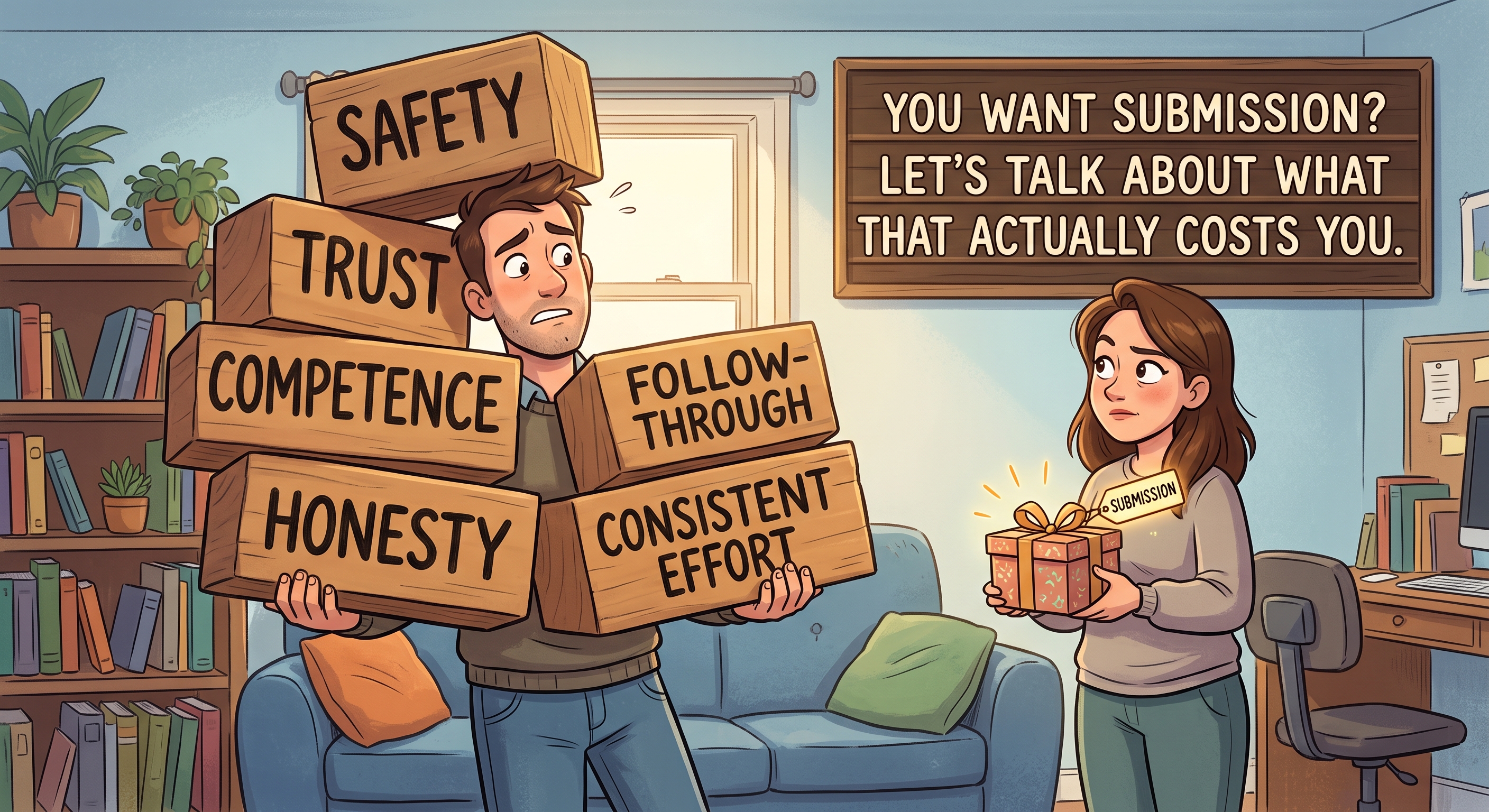

There is a whole genre of social media content right now that I keep running into, and I would like to have a word about it. It is the current wave of posts — many of them explicitly aimed at women, though the argument applies to any human being — about the beauty of submission in relationships. Let him lead. Let him be the head of the household. Let him make the decisions. Trust him. Follow him. Submit.
These posts are usually accompanied by soft lighting, tasteful aesthetics, and a general vibe of feminine serenity. The women in them look calm. The message is that submission produces peace, and that women who resist submission are exhausting themselves by trying to run their own lives.
I want to talk about what these posts consistently leave out. Because there is a piece of this that nobody in that corner of the internet seems interested in discussing, and it is the piece that matters most.
Submission is not free.
It is not a gift the submissive person hands over one time and never has to touch again. It is not a personality trait some people are born with. It is not a spiritual state you achieve by surrendering hard enough. It is a continuous act of trust, and it requires — every single day, without exception — that the person being submitted to has earned and continues to earn the conditions that make submission possible.
The conditions are: safety, security, trust, competence, follow-through, honesty, and consistent evidence that the person leading is actually capable of leading. When those conditions are present, submission can be a genuine and even wonderful thing. It can produce the peace those posts talk about. It can produce the release that comes from knowing somebody else has the wheel.
When those conditions are absent, submission is not peace. It is captivity dressed up in nicer language.
Here is what the posts do not tell you.
If you want another human being to trust you enough to submit to your leadership — you have to be someone worth trusting. This is not decorative. This is not optional. This is the actual price of admission, and it is paid by you, the person asking for the submission, every day, forever, for as long as the arrangement is in place.
The submissive person is not the one doing all the work. That is one of the great con jobs of the current discourse — the framing that submission is what the woman gives, and the man simply receives. It is not. Real leadership, in the context of consensual power exchange, is significantly more demanding than being led. Because being led requires you to trust one person. Leading requires you to be worthy of that trust, in every decision, in every stressful moment, in every situation where the person following you is depending on you to not run them into a wall.
Let me get specific about what leadership actually requires from the person being submitted to.
You have to be safe. Not mostly safe. Not safe when you’re in a good mood. Safe. Consistently. Predictably. The person following you needs to know that you are not going to hurt them, threaten them, dismiss them, or turn on them when things get hard. If your emotional regulation is unreliable, the submission you are asking for is unreasonable, because you have not built the ground it needs to stand on.
You have to be trustworthy. Which means keeping your word. Which means the small commitments as well as the big ones. Which means not lying, even by omission. Which means not doing things behind their back that would matter if they knew. Trust is built in tiny daily deposits and destroyed in single withdrawals, and if you want somebody’s submission, you are asking them to trust you at a level that requires a very healthy account balance.
You have to be competent at the things you are asking to lead in. If you want to lead the household, you have to actually be able to run a household. If you want to lead the finances, you have to actually be good with money. If you want to lead the family’s decisions, you have to actually have the judgment those decisions require. The current posts skip over this part entirely, because a lot of the men being told they should be leading do not, in fact, have the skills to lead. And they are being told to demand leadership anyway. Which is a recipe for a household run by someone who does not know how to run it, while the person who could run it well is being told to be quiet and submit.
You have to be able to hear the person following you. This is the part that most of the content specifically gets wrong. Submission is not silence. A person who has genuinely submitted to your leadership still has information, insights, concerns, and expertise that you need. Real leadership requires you to actively invite that information, receive it without defensiveness, and factor it into your decisions. If your version of being submitted to means the other person cannot disagree with you, offer input, or raise concerns — you are not asking for submission. You are asking for silence. Those are not the same thing.
You have to be able to admit when you are wrong. And to change course. And to say so out loud. Because the submissive person is trusting you to notice when your leadership is off and to correct it. If your ego cannot tolerate being wrong, you cannot be trusted with somebody else’s submission. You will run the whole thing off a cliff before you admit you were the one steering.
You have to be steady under stress. Because the whole point of leadership, in this framework, is that the person following you does not have to carry the weight of every decision. If you fall apart when things get hard, they end up carrying the weight anyway, plus the additional weight of managing your falling-apart. Which means the arrangement is now costing them more than it is giving them.
Now here is the honest thing.
Most of the people posting content telling other people to submit to them are not, in fact, providing any of what I just listed. That is the whole problem. The content is being produced by and for people who want the benefits of being submitted to — the deference, the compliance, the ego lift, the fantasy of being in charge — without the responsibilities of being someone genuinely worth submitting to.
They want the wife who defers to them but they do not want to be the man whose judgment consistently deserves deference. They want the household in which they are the head but they do not want to acquire the actual competencies that heading a household requires. They want to be trusted but they do not want to do the ongoing daily work that produces trustworthiness. They want the aesthetic of leadership without the substance of it.
This is not leadership. This is entitlement, wearing leadership’s costume.
And if you are the person being told to submit —
Please hear me carefully. Consensual submission in a healthy relationship, built on mutual respect and real safety, can be a beautiful thing. It exists. It is real. Some people, in the right dynamic, with the right partner, thrive in that structure. This piece is not against that.
What this piece is against is submission being demanded from you by a person who has not earned it, will not maintain the conditions that make it safe, and is going to use your submission as cover for behavior that would otherwise be recognizable as controlling, dismissive, or abusive. When somebody is asking for your submission and is not demonstrating the safety, trustworthiness, competence, listening, humility, and steadiness the arrangement requires — they are not asking for submission. They are asking for access. Access to your compliance. Access to your labor. Access to your unquestioning cooperation. And they are calling it submission because submission has been rebranded as beautiful and access is a more accurate word for what they actually want.
You do not owe anyone your submission by default. You do not owe it because of your gender. You do not owe it because of your religion. You do not owe it because of tradition, or family expectation, or a genre of content telling you it will bring you peace. Submission is a gift you can choose to give, freely and reciprocally, to a person who has demonstrated they are worthy of receiving it and capable of doing the work required to keep receiving it.
If the person asking for it has not done that work — you are allowed to say no. You are allowed to require the work be done first. You are allowed to notice, at any point, that the work has stopped being done and adjust accordingly.
And to the person asking for submission —
If you want it, earn it. Every day. Forever.
Be the kind of person whose judgment deserves the deference you are asking for. Be safe. Be trustworthy. Be competent. Listen to the person following you like your life depends on it, because their well-being does. Admit when you are wrong. Handle stress like an adult. And keep doing all of those things, without fail, for as long as the arrangement exists.
If you cannot do that — if any of that sounds like more work than you signed up for — then you do not actually want submission. You want the fantasy of it. You want the aesthetics of it. You want the ego lift of being deferred to. And you should be honest with yourself about the difference, because the person you are asking to trust you deserves to know whether you are actually offering leadership or whether you are just cosplaying it.
One last thought.
The reason healthy submission produces the peace those posts talk about is not because submission itself is peaceful. It is because being with someone truly trustworthy is peaceful. The peace comes from the trustworthiness of the leader, not from the surrender of the follower. Which means, if you are looking at a relationship where somebody has submitted and they do not look peaceful — the problem is not that they aren’t submitting hard enough. The problem is that the person they are submitting to has not earned the peace they are supposed to be providing.
Submission without a genuinely worthy leader is not peace. It is exhaustion. And a lot of the women being told to submit their way into happiness are, in fact, submitting their way into ongoing depletion, because the men receiving that submission are not doing the work that would make it restorative.
Real submission is a gift given to somebody who has earned it. Anything else is called something else, and I think it is time we started calling it by its actual name.
Leave a Reply