
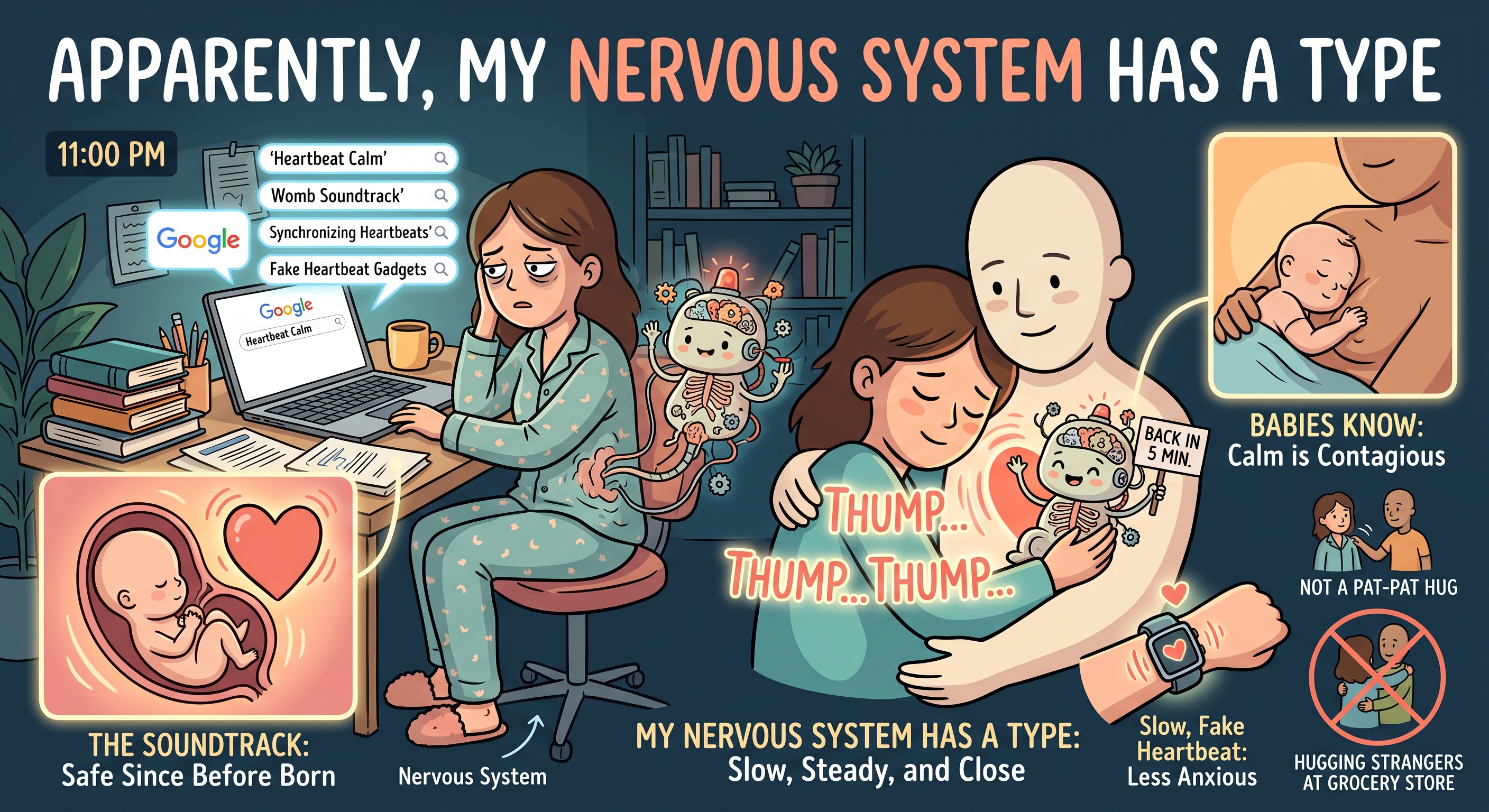
Fair warning: this post started as a feeling and turned into me going down a rabbit hole at eleven o’clock at night, because that is simply how my brain handles feelings. Other people journal. I google things until my eyes hurt. Both are valid coping strategies.
Here is the feeling. Most of us, if we are lucky, can name one person whose hug did something to us. Not a nice hug. Not a polite, pat-pat-see-you-at-Thanksgiving hug. A hug where you put your head on their chest, hear their heart going thump, thump, and your entire nervous system just… clocks out. Put up the little “Back in 5 Minutes” sign. Left the building.
And if you are me, your very next thought is not how lovely. It is excuse me, what just happened, and who authorized that?
So I went and found out. Pull up a chair.
Point one. We were raised on it. Literally.
Before any of us had a face to look at or a single opinion about anything, we lived inside a heartbeat. Hearing develops in the second half of pregnancy, and from then on, your mother’s pulse was the soundtrack. Twenty-four hours a day. No skip button. No shuffle.
And that rhythm always came bundled with warmth, being held, and being fed. So before you ever learned the word safe, your body had already filed a heartbeat under it. It is possibly the oldest item in your emotional filing cabinet, and nobody even asked your permission to put it there.
Point two. Babies know what they are doing.
Most mothers hold their babies on the left side, right up near the heart. Right-handed, left-handed, doesn’t matter. People have been arguing about why for sixty years, and I am not going to settle it here, but the babies certainly don’t seem to mind the location.
And when newborns lie skin-to-skin on a parent’s chest, their heart rate, breathing, and temperature settle down. Babies who get a lot of that chest time early on have even been shown to handle stress better years later. Years. From lying on somebody. I would like that return on investment for my retirement account, please.
Point three. We never actually grew out of it.
You would think adults would have evolved past needing to be soothed like a newborn. You would be wrong. We just got better at pretending.
When two people who care about each other hold hands, their breathing and heart rates start falling into step. Nobody decides to do this. Nobody fills out a form. Two grown adults, hearts marching together, completely without permission.
It also matters whose hand it is. A trusted person’s touch calms the brain’s alarm system way more than a stranger’s does. So no, you cannot just hug a random person at the grocery store and expect the same result. Please do not hug people at the grocery store.
And here is my favorite part: a slow heartbeat calms us down even when it’s fake. People have worn little wrist gadgets that pulse like a slow heartbeat and felt less anxious before giving a speech. A fast fake heartbeat does the opposite, which honestly explains every horror movie soundtrack ever made.
Point four. So what is actually going on in there?
The short version: bodies talk to each other. Your brain is constantly checking your insides to decide whether you are safe, and when you are pressed up against a slow, steady heartbeat, it takes the hint. Calm is a little contagious. Add in some bonding chemicals that get released with warm, trusted touch, plus the fact that you have associated a heartbeat with safety since before you were born, and your nervous system basically goes, oh, I know this one, and sits down.
That’s it. That’s the science. I promised this wouldn’t be a lecture.
Point five. And this is the part I want to be honest about.
I am going to be sincere for a second, because the rest of this was fun and this part isn’t really a joke.
If there has only ever been one person whose chest made your whole body go quiet, you did not imagine it, and you are not being dramatic. It takes two things for that to happen. It takes someone whose body carries a steady, unhurried rhythm. And it takes a nervous system, yours, willing to stop scanning the room long enough to receive it. A lot of people stay slightly braced even in a hug. When both halves finally line up, your body does something it has known how to do since before you had a name.
Which means the capacity for that calm is yours. Someone may have brought it out of you, but it happened in your body. Knowing what it feels like isn’t just a memory. It’s information.
In conclusion.
I set out to understand one hug and ended up learning about womb soundtracks, baby-holding habits, and a wrist gadget that pretends to be a heart. This is a longer answer than the question probably deserved. It is also, I think, the correct one.
So here is where I have landed: my nervous system has a type, and the type is slow, steady, and close. Honestly, that’s more self-awareness than most dating profiles manage.
I am going to go make some tea.
Leave a Reply